
Where Kentucky City Directories Are Held
Kentucky's historical directory record is a set of local runs, not one statewide book. Louisville has a notably long series, while Lexington has city, telephone, business, street, rural, and farm editions. Other cities appear in the Kentucky Historical Society's multi-city holdings, county libraries, or FamilySearch catalogs. Years are uneven, so a missing edition in one library does not show that no directory was printed. Check the holding institution's catalog before planning a visit.
| Collection | Verified Years or Scope | Where Held | Access |
|---|---|---|---|
| Louisville printed volumes | 1832 to present at LFPL; Metro Archives through 2000, excluding Civil War years | Louisville Free Public Library and Louisville Metro Archives | Reference shelves, archives library; online scanning varies |
| Lexington city and cross directories | 1864-65, 1877-78, 1906-07, 1923 | Lexington Public Library Kentucky Room | Digital browse and physical holdings |
| Polk's Lexington by R.L. Polk and Company | 1940-41 | Lexington Public Library digital collection | Scanned title and image access |
| Lexington telephone, business, street, and subdivision editions | 1933, 1942-43, 1942, 1944, 1956, 1958 | Lexington Kentucky Room and digital archive | Browse scans; physical reference material |
| Fayette rural and farm directories | 1912, 1940, 1971 | Lexington digital archive | Digital titles and images |
| Kentucky Historical Society holdings | 24 cities; Danville examples span 1942-1987 with gaps | Martin F. Schmidt Research Library and KHS Digital Collections | Catalog, book, microfilm, microfiche, or staff request |
| Other Kentucky city runs | City and county coverage varies | FamilySearch catalogs, county libraries, and the Library of Congress directory inventory | Affiliate access, print, or microfilm depending on item |
These records have real gaps. Metro Archives notes missing Civil War years in its Louisville run, and the KHS Danville examples jump between selected dates rather than forming an annual sequence. Some collections are paper or microfilm only; online images depend on digitization rights and can stop before the physical holdings do. The latest year shown in a catalog is not proof that a book was published every year before it.
Kentucky City Directory Shelves
Louisville researchers can begin with the Louisville Free Public Library Kentucky History Room, whose listed resources include printed directories from 1832 to the present, suburban directories from 1957, and census material from 1810 through 1950. The Louisville Metro Archives holds its own city and suburban volumes, maps, land, marriage, and will records. Its researcher library is at 635 Industry Road, and the official page gives current visitor details. A book on a reference shelf can answer a different question from an online scan: staff can point to a neighboring year, a street index, or a related map.
The Lexington Public Library's Kentucky Room is a separate local-history route. Its collection description includes directories, newspapers, maps, local documents, selected census and vital sources, and the local-history index. The room also offers HeritageHub and branch access to Ancestry Library. These resources can help test a name or address found in a printed volume, but their coverage depends on the collection and the account or branch being used.
For an overview of the Kentucky Room's local-history holdings and reader services, consult the Lexington Public Library genealogy and local history page.
The room's directory shelves sit alongside other sources that can help explain a household's address or a name variant.
Kentucky City Directories in Lexington
The Lexington Public Library digital browse lists several distinct publications rather than one continuous series. It identifies the 1877-78 Lexington City Directory and Gazetteer by R.C. Hellrigle and Company, Polk's 1940-41 Fayette County volume by R.L. Polk and Company, business and professional material for 1942-43 from the Lexington Advertising Agency, and telephone books for April 1933 and March 1944 from the Lexington Telephone Company. The archive also includes a 1912 rural directory, a 1940 Fayette County Rural Directory, and a 1971 farm directory. Each title serves a different map of the community: downtown addresses, telephone subscribers, businesses, farms, or county roads.
The browse record can expose a title, volume or year, publisher, publication date, place, subject, and image link. A failed word search may reflect the scan or its index, not a missing name. Open the page image when possible, and use the title details to cite the edition rather than assuming all books with similar names cover the same area.
For another Kentucky collection, the Kentucky Historical Society directory record describes holdings across 24 cities and statewide gazetteers.
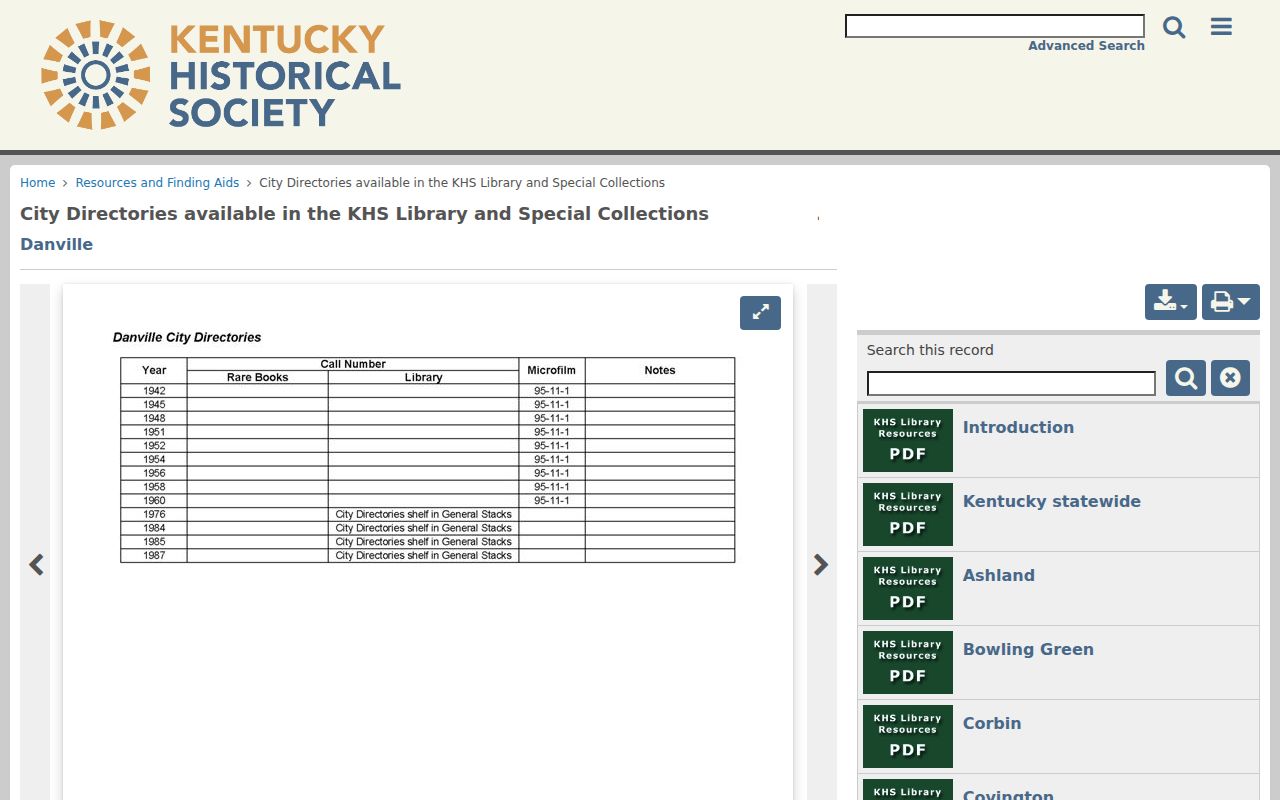
The KHS catalog route complements city-library shelves and helps identify a volume before requesting staff assistance.
Read a Kentucky City Directory Entry
Read the printed page as a set of clues whose exact fields vary by publisher and year. The Lexington digital browse shows title, volume, publisher, date, place, subject, and image access at the collection level; entry details vary by edition. In the book itself, record only the fields the page prints, then check the edition's key before interpreting a short mark. An entry can help locate a family in a year, but it does not prove that every listed person owned a property or lived there for the whole year.
| Person and household | Name, initials, and a spouse or household notation where printed |
|---|---|
| Work or business | Occupation or employer/business detail in editions that include it |
| Address | Street and house number; apartment or rural route where shown |
| Household marks | Edition-specific owner, boarder, widow, deceased, or removed notation |
| Reverse lookup | Street-order or business section, when that volume includes one |
- Criss-cross section
- A street-order section that helps move from an address to a listed occupant in that edition.
- Householder index
- An alphabetical name list used to find a person before turning to the full entry.
- Abbreviation key
- The publisher's guide to short marks; check it before reading initials or household symbols as facts.
The 1877-78 catalog record gives publisher, date, place, title, subject, and image access; check the printed page for an individual's fields.
Kentucky City Directory Street Sections
A cross or street section changes the direction of the search. Instead of starting with a surname, start with a known street and address, then check whether the edition lists an occupant there. Lexington has street and subdivision material dated 1942, 1956, and 1958. Louisville's longer city series creates many more possible years, but the coverage and section order still need to be checked volume by volume.
Use the current address only as a first pass. Street names, numbers, and city limits can shift, so look for old spellings, directions, suffixes, and a nearby subdivision name. If a street section is absent, return to the alphabetical list and check adjacent editions or the library catalog for a separate reverse directory. A directory's street section is useful for historical house research; it is not a substitute for a present-day parcel record.
Kentucky Directory Dates and Annexation
Several Kentucky editions make a useful time bridge. Louisville's series begins in 1832. Lexington's digitized holdings include an early 1864-65 book, later nineteenth-century volumes, and multiple twentieth-century city, business, telephone, street, and farm titles. The 1958 14th edition Lexington street and subdivision directory is especially notable because it records city-limit numbers, annexed areas, subdivisions, country roads, and metropolitan streets. That detail can explain why an address seems to fall outside a modern city search.
- 1832: Louisville directory coverage begins in the LFPL series.
- 1864-65 and 1877-78: Lexington volumes mark early city and gazetteer examples.
- 1942-58: Lexington business, street, subdivision, and telephone material adds alternate address views.
- 1958: city-limit and annexation notes help reconcile older Lexington place labels.
These dates describe identified holdings, not an unbroken annual run. Use a map or plat to test the boundary question, and note the volume's own date and publisher in any family-history record.
Trace Families With Kentucky City Directories
A family-history search works best when it keeps the person, place, and edition tied together. The steps below use an old volume as a dated household snapshot and pair it with census, map, and obituary records where those sources exist. The federal census is publicly released through 1950 under the 72-year rule, but the 1890 population schedules were mostly lost; surviving Kentucky Union-veteran schedules cover only listed counties and are not a full replacement.
- Choose a likely city, county, and year, then search the surname list and keep the printed spelling and initials.
- Copy the address and any spouse, household, or work detail actually shown; note the publisher and edition year.
- Check the street-order section for that same address, especially when the name search is blank.
- Compare the nearest census year for household members and relationships, keeping the different date and purpose of each source clear.
- Use maps, obituaries, cemetery records, or probate references to test a move or a later life event.
A name that disappears may signal a move, a change in the book's coverage, a gap in the surviving run, a spelling shift, or a household member no longer separately listed. It does not establish a death or a final address. Compare the next available edition with a newspaper or cemetery source, and use a county deed or tax record only for the ownership question. Keep a citation for each edition so a later reader can repeat the search.
Kentucky Directory Gaps and Limits
No single Kentucky catalog holds every city, year, or format. Louisville's Metro Archives run has stated gaps, Lexington's digitized titles are selected editions, and smaller city runs may sit in a local library or a FamilySearch catalog. Image access there can depend on rights, login, an affiliate library, or a FamilySearch Center. The Library of Congress directory inventory is useful for microform and electronic holdings, but Kentucky coverage remains city by city.
Titles also describe different groups. A telephone book is not the same as a full household directory; a business and professional edition does not cover every resident; rural and farm books follow roads beyond city limits. A catalog result confirms that a title is held or described, not that every page is online or that every person appears. Use the volume's own introduction and index to learn its boundaries.
Kentucky Directory Research Help
When a scan ends, the next route is usually local. Ask the city library's reference staff about print volumes, microfilm, alternate years, and the exact street section. The Kentucky Historical Society research service accepts a single-record request for one person and one indexed record for $21.20 including tax, or hourly work at $47.70 for members and $53 for nonmembers; completion can take up to eight weeks. KHS does not promise a complete house history.
The Kentucky Department for Libraries and Archives Research Room is open Monday through Thursday, 9:00 a.m. to 3:30 p.m., and closed Friday; appointments are advised, and phone help is available on weekdays. KDLA has county-record guides and microfilm, but its own guidance says county coverage varies and inventories are not complete. Call or check the current official page before traveling. County libraries and historical groups can also hold editions not listed in a statewide catalog.