
Finding Kentucky Residents by Record
A useful search begins with the fact you want to confirm. A name may lead to a parcel owner, a voter may confirm their own registration, and a court index may show a case party. None of those lists every resident in Kentucky. The Commonwealth has 120 counties, and most land, tax, and court records follow the county where the property or case sits. First name the county, or make a short list of likely counties from an old address, family paper, or known event.
Then work from the source that can answer that question. For an owner, use the county Property Valuation Administrator (PVA), the local assessor. For a person checking their own current voter record, use the State Board of Elections' Voter Information Center. A court name match is only an index lead; the county Office of Circuit Court Clerk holds the case file. For older households, library directories, newspapers, tax lists, and deeds can fill gaps that a current roll cannot.
A Kentucky residents directory search works best when the county, record type, and time period stay attached to every result.
- Write down the county, the name as used at the time, and whether the question concerns a person, parcel, court case, or family event.
- For property, look up the address or parcel through that county's PVA, then keep the situs address separate from the tax-mailing address.
- For voter status, let the voter check their own record in the state tool; use a list request only when an authorized purpose applies.
- For a court matter, search CourtNet where access permits, then ask the county clerk for the official file using a case number or other known detail.
- If the online index ends, contact the custodian, library, or Kentucky archives with a specific record type and date range.
Keep the question narrow. An owner record, voter match, directory entry, and court party are separate facts; compare two reliable details before treating them as one person.
Kentucky Offices for Resident Records
Kentucky has no single office that keeps every address, ownership, or court record. The local county clerk records deeds and marriage licenses; the PVA assesses property; the sheriff handles property-tax collection; and the Circuit Court Clerk maintains official county case files. The Kentucky Department of Revenue's local-official directory is a starting point for finding county PVA, clerk, and sheriff contacts. Use the county where the property or event occurred.
Kentucky State Archives
Frankfort research room
Monday-Thursday, 9:00-3:30
(502) 564-1770
Kentucky Office of Vital Statistics
275 East Main Street
Frankfort, KY 40621
(502) 564-4212
Kentucky State Board of Elections
140 Walnut Street, Frankfort
Voter-file orders by mail or email
(502) 573-7100
Kentucky Searches Begin With a County
A statewide address search must branch to the right county. Kentucky has no universal owner-name portal and no single public deed index. The Department of Revenue's PVA directory points to local property offices, while each county clerk sets its own land-record portal, image range, counter access, and copy process. Fayette County's online index is a useful example, but its coverage is not a statewide cutoff.
Fayette's deed search can look for a name as grantor or grantee, or use an address, lot and block, book-page number, date range, consideration range, or document type. The inspected interface caps results at 1,000 records, so a broad query may need a tighter date or name. The Fayette controls are a county example, not a statewide form.
| Portal and key | Type | Required or access | Use or result |
|---|---|---|---|
| Fayette deed index: grantor or grantee | Name radio and text fields | Optional search fields | Search one name against both parties or choose one party |
| Fayette deed index: street and legal details | Address, subdivision, lot, block, instrument, book, page, description | Optional | Narrow a parcel or locate a document |
| Fayette deed index: date, amount, document group | Date range, consideration range, checklists | Optional | Filter deeds, mortgages, liens, plats, wills, and other instrument types |
| Fayette deed index: sample result | Indexed record fields | Availability varies by record | Grantor, grantee, instrument type, recorded date, control number, book/page, legal or address description, consideration where indexed, and image availability |
| Kentucky Voter Information Center: legal first and last name | Text fields | Both required | Check a person's own current registration |
| Kentucky Voter Information Center: birth date | Date field | Required | Use the requested MM-DD-YYYY format |
| Kentucky Voter Information Center: SSN last four | Short text field | Optional | Optional matching field on the official form |
| CourtNet 3: case search | Jurisdiction selector and case number | Both required for case mode | Locate a known case |
| CourtNet 3: party search | Last name, first name, birth date, DLN, or SSN | Use one supported combination; name fields require at least three characters | Name match may be Exact, Starts With, or Sounds Like |
| CourtNet 3: sample result | Case index and docket | Images depend on role or plan | Party and role, case number, court, category, filing date, status, docket events, hearings, disposition, and linked images where permitted |
Older Fayette material has separate routes for non-indexed documents and old index books. In other counties, ask the clerk whether a public terminal, older deed books, or a request by mail can fill the gap. The statewide Kentucky Geography Network supplies maps and services, but local PVA and clerk systems remain the path to ownership records.
Current Kentucky Resident Rolls and Directories
Current records in Kentucky are spread across state and county offices. No public statewide owner-name search replaces the local PVA. A person may appear as a voter, business officer, license holder, or case party without appearing in the other systems, and each source has its own access rules.
| Source | Who It Lists | Keeper | Access |
|---|---|---|---|
| Property valuation roll | Assessed owners and parcel details | County PVA | County portal or office; fields vary |
| Voter Information Center | A person checking their registration | State Board of Elections | Self-check with name and birth date |
| Land-record index | Parties to recorded deeds and liens | County clerk | County portal, public terminal, or copy request |
| Business entity search | Entity officers, managers, agents, and filings | Secretary of State | Online search; a filing does not prove ownership |
| License directory | Licensees in listed professions | Professional licensing boards | Directory filters, then board verification |
Use the Kentucky Secretary of State business search for an entity, officer, or registered-agent filing, and the Active License Directory for a public license entry. Those results show an official role or filing, not every person connected to a business. For the steps and limits involved in checking one person across records, see the Kentucky resident lookup.
Kentucky Voter Lookup Fields and Limits
The Kentucky Voter Information Center lets a person check current registration, polling place, and absentee-ballot status. Its visible fields are legal first name, last name, date of birth, and an optional last four digits of the Social Security number. The tool is not a public browse-by-street list.
The voter fields shown in the Kentucky search table require a legal name and birth date. Full voter lists follow KRS Chapter 116 and 31 KAR 3:010. An SBE-84 request includes an eligibility statement and an oath against commercial use or resale; it is not a general-purpose people list. Ballot choices remain private. Five-year voting history, where included in an authorized list, records participation rather than a person's vote.
Kentucky CourtNet Records in a Resident Search
CourtNet 3 is Kentucky's statewide court-data access point, but sign-in and the user's role or plan determine what is visible. Official help describes party searches using a three-character last name and a first name, birth date, driver's-license number, or another supported combination. A business search needs a jurisdiction and business name. Exact, starts-with, and sounds-like options help address spelling variants.
A result is an index lead, not the court file. The sample result fields in the Kentucky search table are only the common case and docket details described by research. The Kentucky Court of Justice directs requests for Circuit, District, Family, and Business Court files to the county Office of Circuit Court Clerk. Give the clerk a case number, county, party name, or filing date and ask where the official file is held. Sealed, juvenile, adoption, and expunged material is restricted, and access to linked images depends on the portal role.
Kentucky Vital Records by Event Year
The Office of Vital Statistics keeps Kentucky birth and death certificates from 1911 forward, with delayed birth registrations as an exception. Central marriage and divorce registration begins in June 1958. Earlier marriage licenses belong with the county clerk that issued them; earlier divorce records and decrees go to the circuit clerk. The date changes which office can help.
KRS 213.131 makes vital-record information confidential except through authorized routes. Annual birth and death lists are open, while full birth records become public after 100 years and death records after 50 years. A current certificate requires the current OVS form and eligibility rules. OVS lists $10 for a birth search or copy and $6 for a death, marriage, or divorce search or copy under 901 KAR 5:050.
Use the official OVS forms directory for VS-37, VS-31, and VS-230. Orders can be made in person or by mail, and the state identifies VitalChek as its authorized online and phone partner. KDLA and local libraries help with older registers, cemetery records, and newspapers when no central certificate exists.
Historical Kentucky Resident Directories
Old directories can pin a name to a street for one publication year. Louisville Free Public Library lists city directories from 1832 to the present and suburban directories from 1957 onward. Lexington's Kentucky Room holds digitized runs that include 1864-65, 1877-78, 1906-07, 1923, and several twentieth-century street, telephone, business, rural, and farm editions. These are local collections, not one complete statewide series.
The Lexington Public Library Kentucky Room also points to newspapers, maps, obituary tools, and historical indexes. A directory entry is evidence for its year, not proof of a current address or legal ownership. For the collection-by-collection account, use the Kentucky city directory collections.
Why Kentucky Searches Need Old County Names
Kentucky's county map changed for more than a century. McCreary County became the 120th county in 1912, so an older deed, tax list, or court entry may sit under a parent county rather than the modern county name. Before treating an empty search as a dead end, check the county formation chart and the county record inventory for the year in question.
Statewide birth and death registration began in 1911, after incomplete registration efforts in 1852 and 1874. The 1890 federal population schedules were mostly lost. Kentucky's surviving Union-veteran schedules cover only their listed counties and category, so they cannot stand in for a full census. KDLA's courthouse-disaster inventory can explain a lost volume; microfilm, a reconstructed index, or a library copy may preserve part of the record.
The Kentucky State Archives research room holds county deeds, wills, tax lists, court material, census records, and military files across about 70,000 microfilm rolls. It is open Monday through Thursday, 9:00-3:30, and an appointment is recommended. Check its visit and research guidance before planning a records request.
Kentucky Unclaimed Property Name Search
A name in the Kentucky State Treasury's unclaimed-property system can point to an old account or a possible heir connection. A match is a lead to a claim, not proof that the person currently lives at the address on file. Only the owner, an heir, or a court-appointed representative may claim property, and the Treasury keeps claimant Social Security numbers confidential.
The official search is free. Collect the record details and use the site's claim process; do not pay a caller or letter writer simply to search the state database. If a family member has died, probate documents may be needed to show authority. The county court or clerk that handled the estate can explain which public filings exist.
The Treasury page shows its name and property search controls.
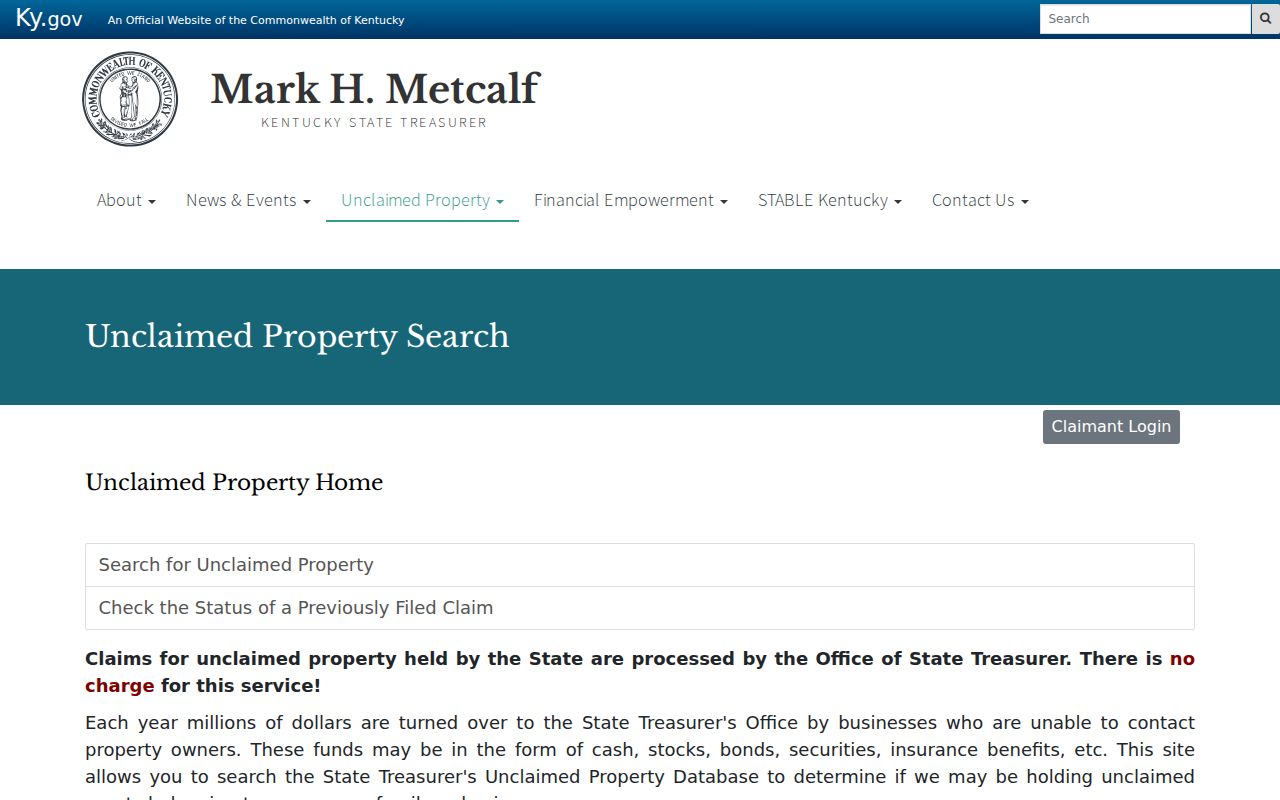
Its claim-status tools support follow-up on a specific property entry, while the underlying records remain with the Treasury.
Kentucky Statewide Custody Searches
For a current custody question, Kentucky has a state offender lookup and VINE notification service, but county jail rosters remain local. The Department of Corrections explains its data limits: updates are made daily, yet information from the newest 120 days may not be final. VINE offers custody-event alerts by phone or email; it is not an address directory.
The statewide offender page also describes VINE and its 1-800-511-1670 number. For a county jail booking, use the detention center or sheriff for the county involved. Each county controls its own roster and status feed, and there is no single statewide county-jail search. A result about custody should be checked with the responsible agency before a family member acts on it.
The Kentucky Corrections lookup and disclaimer page sets out its update caveat and VINE route.
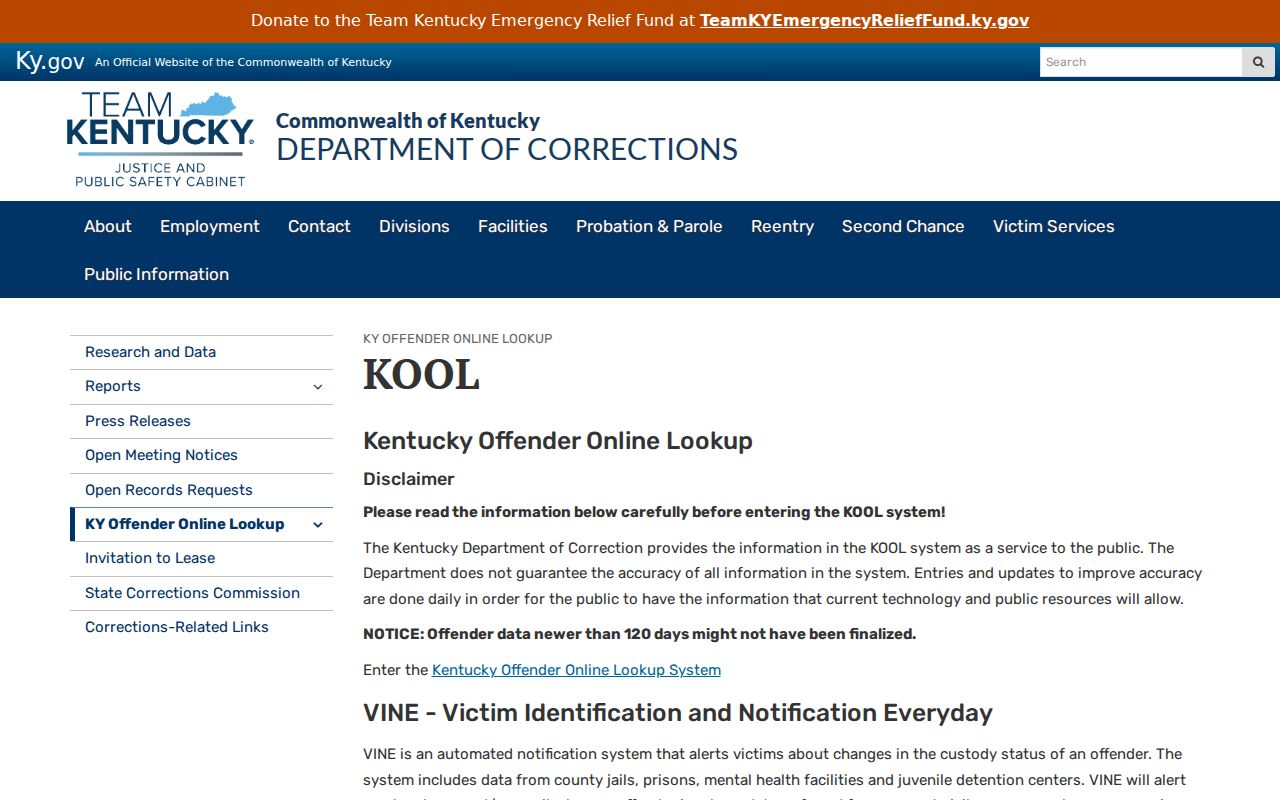
That notice helps distinguish an offender-status record from a current household or residence record.
Kentucky Safe at Home and Privacy Limits
Kentucky's Safe at Home program serves eligible survivors of domestic violence, stalking, trafficking, and specified sexual crimes. Under KRS 14.300-14.318, the Secretary of State provides a substitute address, forwards mail, and masks participant addresses in many state and local records, including voter records. Certification lasts four years unless it is cancelled or withdrawn, and may be renewed.
The program does not hide real-estate holdings. A public parcel record may still show a property even when another record displays the substitute address. That gap is a reason to respect the program, not to piece together a protected person's location. Kentucky's anti-stalking law and the limits in voter, driver, vital, and court records all matter when reading a match.
Use public records lawfully. Do not use an address, name, or record trail to stalk, harass, threaten, or harm someone. For a correction or access question, contact the office that keeps the original record.
The Kentucky Safe at Home program explains eligibility and address protection. Its rules also clarify that real property is not masked by the substitute address.
Kentucky Record Access Changes in 2026
Access details can change even when the old record does not. The Kentucky Consumer Data Protection Act took effect January 1, 2026. It gives rights against certain private data controllers, but publicly available information and government public records are excluded. It does not erase a county deed, court file, or voter record. For public material, ask the original custodian to correct an error or explain an access limit.
Kentucky's current vital-record regulation, 901 KAR 5:050, was revised effective October 13, 2025. Use the live regulation and current OVS forms for fees and ordering steps. Voter-file distribution also follows current 31 KAR 3:010 rules and the SBE-84 form. The county clerk, state agency, and archive each control their own records and request routes.
A September 2025 Kentucky Geological Survey grant will support preservation and digitization of oil and gas records. That is a developing historical resource, not a statewide resident search. Check KDLA's electronic-records program for preservation updates, then confirm that a particular county's files have actually been indexed before relying on an online search.
Kentucky Indexes and Certified Records
An index, search result, and certified copy serve different needs. A county deed index points to a recorded document; a CourtNet entry points to a case file; a vital-record list gives limited public facts. A certified copy comes from the official custodian under its own eligibility and fee rules. Start with the index when you need to locate a filing. Ask the agency for a certified or full record only when you are authorized and need that form.
For public inspection or a copy of another state or local agency record, the Kentucky Open Records Act, KRS 61.870-61.884, is the request route. Send a written request to the official custodian and describe the record, date range, and preferred format. KRS 61.880 requires a written response within five working days or a written delay explanation and earliest availability date. Copy fees generally reflect actual reproduction costs; exempt records may be withheld or redacted under KRS 61.878.
Use the source-specific route for vital and court records, since confidentiality, sealing, and clerk rules still apply. A request should name the record class and county, not ask an office to create a new search or conduct a title investigation.